The second trend is the global expansion
Process engineers now benefit from accessible computing power that correlates equipment status, process context, and wafer results. This data-linking capability helps maintain strict process variation control at the nanoscale. The most robust quality control strategy connects material data, equipment information, and final wafer results to detect subtle variations before they impact manufacturing yield.
Latest news
 Anker Unveils Playful 45W Charger With Animated Face Display
 Google Docs Web Version Still Missing Native Dark Mode
 Anthropic-Linked Vulnerability Exploited From China, Targets US and Japan
 Text‑Based AI Agents: Your New Digital Assistants
Jon Holt, global fab application solutions manager at PDF Solutions, points out that a material might pass incoming specifications, yet its processing behavior can be affected by delivery line conditions, thermal history, residence time, process chamber state, or material interactions. Modern equipment control and data collection systems preserve this context by enforcing operating limits, flagging deviations, and halting processing when critical parameters leave approved ranges.
Russell Dover, general manager of equipment intelligence product development at Lam Research, identifies three major trends driving equipment intelligence. The first is soaring manufacturing costs and the critical need to maximize productivity and return on investment from existing assets. Dover notes that when his career began in a UK fab over 30 years ago, a total facility cost roughly 20 million dollars. Today, that sum barely buys a single set of tools, while a gigafactory costs around 20 billion dollars.
The second trend is the global expansion of fabrication facilities, as companies seek to replicate production capabilities across entirely different geographic regions. This creates fascinating challenges in managing multi-site equipment fleets. The third trend is a severe talent shortage, which fuels the demand for automation, artificial intelligence, machine learning, and robotics. The goal is not to replace people, but to let robots handle monotonous tasks while harnessing human ingenuity alongside the speed of algorithms.
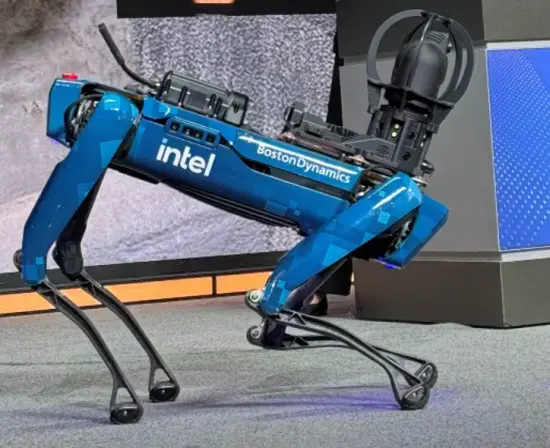
Intel Deploys Quadruped Robots for Real-Time Fab Monitoring
Intel Foundry utilizes a quadruped robot developed by Boston Dynamics to monitor equipment conditions in real time, operating largely behind the scenes in the subterranean utility areas of the fab. In these spaces, motors, pumps, and electrical gear can emit thermal signatures indicating impending overheating. Faulty motors vibrate, and air or specialty gas leaks produce high-frequency sounds that acoustic imaging systems can differentiate from background noise. These robots can also navigate tight spaces to record readings from analog and digital pressure gauges.
The robot deployed by Intel Foundry, named Chip, plays a vital role in maintaining equipment health across multiple facilities. It eliminates the need for technicians or engineers to visit physical locations merely to log routine readings and report them to a primary controller. To date, Intel reports that its robots can perform 16 different preventive inspection tasks. They utilize visual, thermal, and acoustic inspections, alongside lidar sensors and RealSense depth cameras, to improve data quality and minimize safety risks.
Joe Robinson, IoT and robotics architect at Intel Foundry, shares an example where the robot Chip detected hot water flowing unexpectedly through a line connected to a powered-off pump during a routine inspection. The robot alerted nearby technicians, allowing them to safely isolate the pump for diagnosis. Technicians discovered a failed internal seal. This proactive human-robot collaboration prevented a severe hot water leak and avoided potential equipment damage.
In daily fab operations, Intel Foundry uses the Chip robots for several key tasks. Thermal inspections identify overheating motors, pumps, and electrical components before failure occurs. Acoustic inspections detect abnormal operational sounds, potential gas or air leaks, and mechanical issues with distinct acoustic signatures. Finally, visual inspections leverage cameras and artificial intelligence to repeatedly examine machinery, pressure gauges, and other hardware components.
Comments
Leave a comment