Testing Model Stability
My phone has an Exynos 2200 processor and 8 GB of RAM. Android uses about 7.3 GB of this memory. I knew memory was a critical constraint. I considered a dedicated app like PocketPal or running a llama server via Termux. I started with PocketPal due to its simple interface. It filters models compatible with detected hardware. Seven options appeared, from Gemma 3 1B to Gemma 4 E2B, plus Bonsai and Phi-4 Mini. Given my positive experience with Gemma 4 E4B on my PC, I targeted the E2B version. However, 4.6 GB of the 8 GB was already in use.
Latest news
 Smart TVs frequently lose their Wi-Fi connection, leaving viewers staring at a spinning loading icon
 Why Ignoring Car Software Updates Is Risky
 Apple's foldable iPhone Duo introduces dual-display multitasking capabilities
 FCC Weighs Reciprocal Limits on Foreign Satellite Firms
Performance Discrepancies
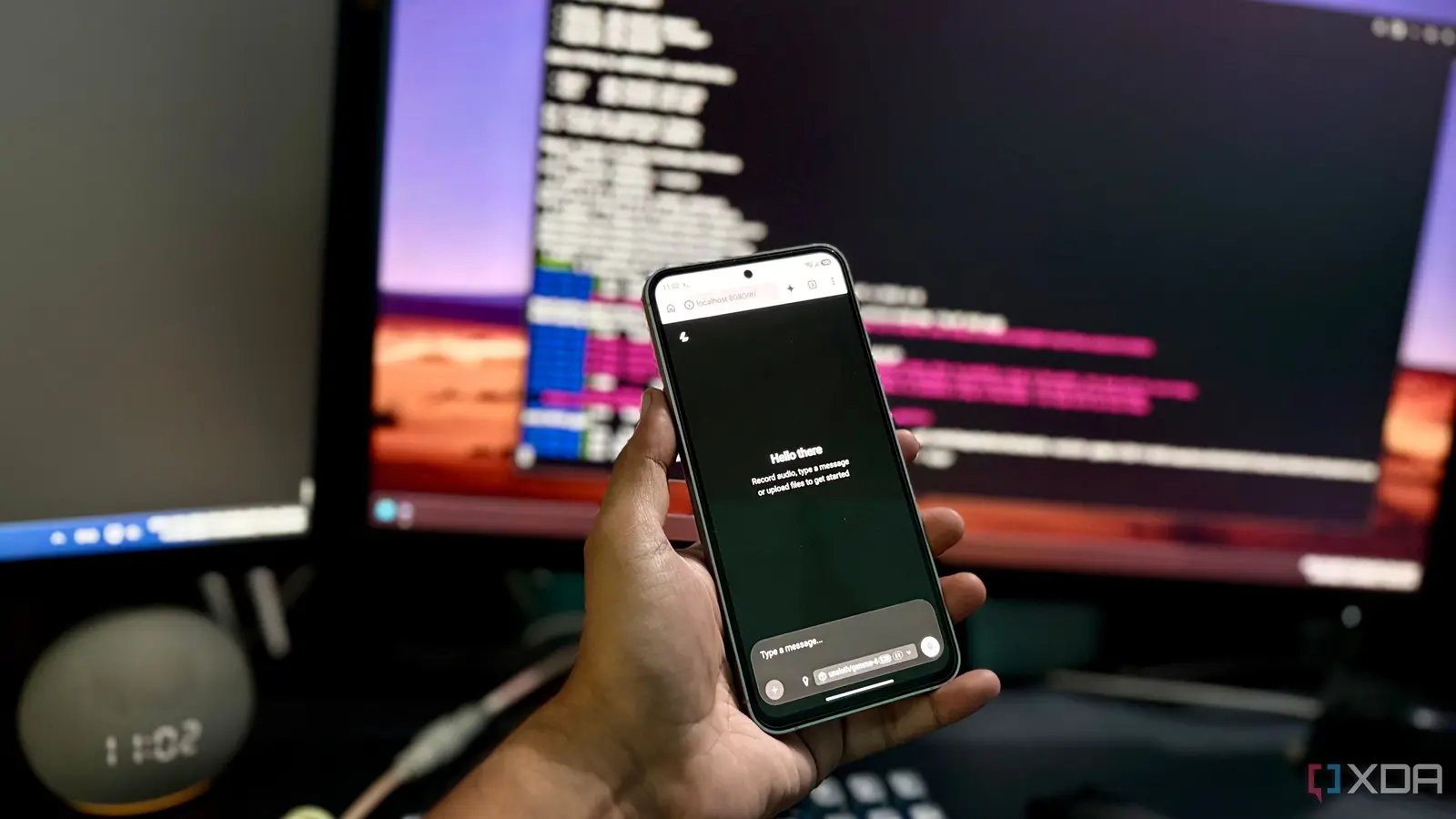
I began with the smallest model, Gemma 3 1B. It ran without causing phone throttling. Next, I tried loading Gemma 4 E2B. A memory warning appeared. The application subsequently crashed multiple times. This suggested PocketPal's mediation layer was the issue. Termux became my only option. I installed the llama-cpp package through Termux. I loaded Gemma 4 E2B using the Unsloth Q4_K_M construction. This model is 2.8 GB on Hugging Face with about 4.65 billion parameters, including embeddings. The model loaded fine, and I started the server on localhost:8080. RAM usage seemed normal.
The speed was surprisingly slow, but only when actively watching the screen. Using the llama web interface, a simple prompt yielded poor results. The 103-token prefill ran at 1.27 tok/s. Generation was only 0.11 tok/s, taking 1 minute and 11 seconds for eight tokens. A second prompt, summarizing a short paragraph, remained slow. The 194-token prefill hit 1.54 tok/s. Generating 68 tokens took 11 minutes and 56 seconds at 0.09 tok/s. I checked power settings; battery limits were not the cause.
Finding a Usable Solution
I then tested Qwen 3.5 2B, a 1.18 GiB Unsloth Q4_K_M model. It performed just as poorly. I returned to PocketPal, expecting no crashes. The model loaded perfectly. PocketPal's benchmark showed 54.54 tok/s for prefill and 11.14 tok/s for generation. Real-world tests achieved a usable rate of about 9 tok/s. Most generations had hallucinations, but I kept it since E2B failed. A persistent doubt remained about Termux background operation. I ran a llama-bench test in Termux via SSH from my PC. Results for Qwen 3.5 and Gemma 4 were completely opposite, confirming my suspicion.
Comments
Leave a comment