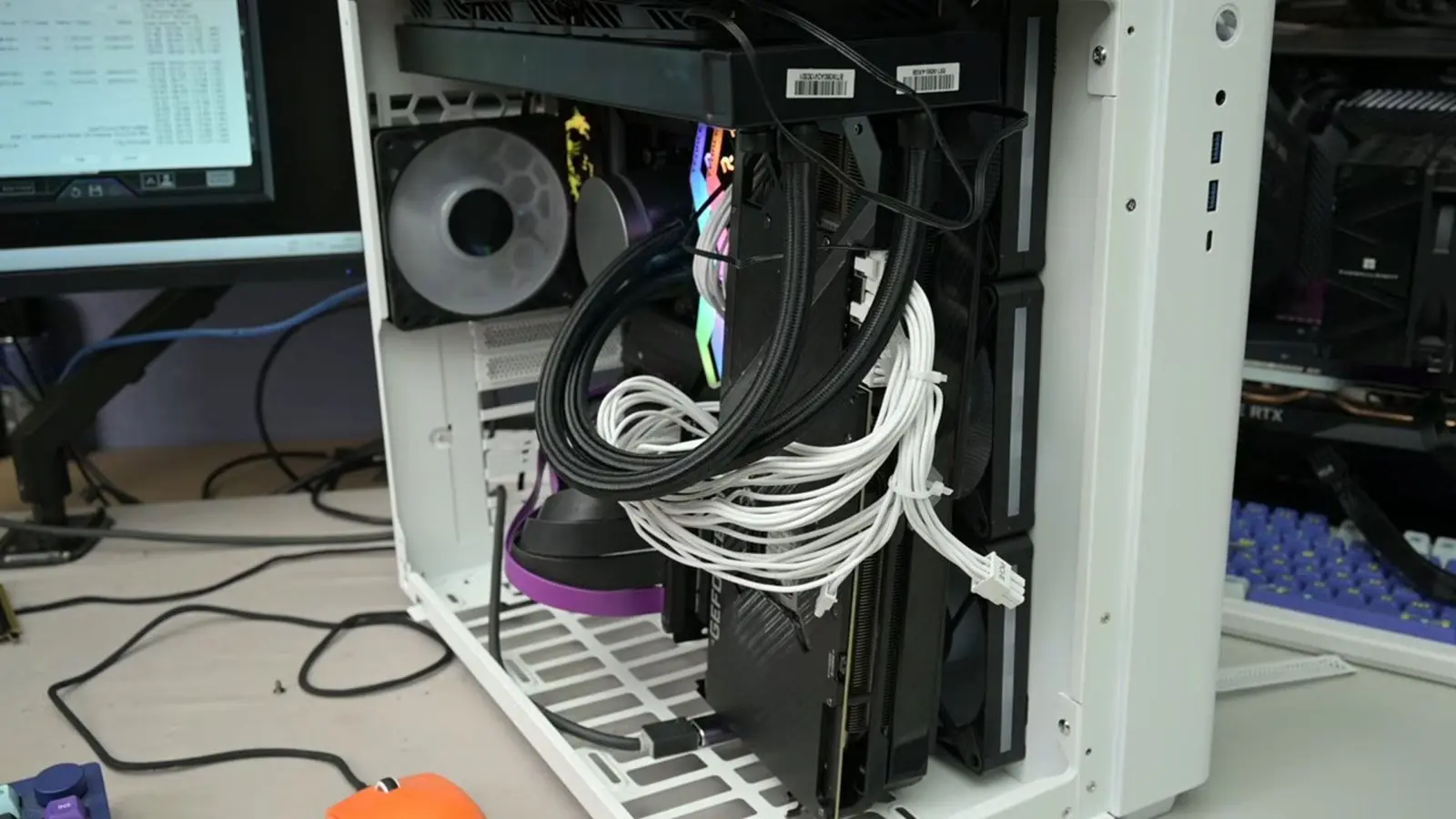
The hotspot measurement, taken directly from the GPU's sensor array
A PC hardware enthusiast known as TrashBench discovered that mounting a graphics card in an unconventional orientation significantly reduced its hotspot temperature during testing. The experiment, conducted in October 2026, challenged long-standing assumptions about optimal GPU airflow in desktop builds. By repositioning the card so its fans faced a different direction relative to case ventilation, the modder observed a measurable drop in thermal readings without compromising overall system stability. The findings emerged from a series of benchmark runs where TrashBench compared standard vertical GPU installation against alternative angles. While the absolute best cooling configuration for the GPU alone came at the cost of higher CPU temperatures, the modder emphasized that balancing both components yielded the most effective result. He noted that decades of PC building tradition have reinforced certain mounting practices, but real-world testing can reveal overlooked opportunities for improvement.
Latest news
 Anthropic Unveils Claude Duet For Background AI Tasks
 Eiliko Creator Hires Independent Security Firm After Flawy Robot Charm Exposed
 Musk Compares Optimus Robot Training to Raising a Toddler
 Atari VCS Software Store Closes in February 2027
The hotspot measurement, taken directly from the GPU's sensor array, showed a consistent 19-degree Celsius reduction when the card was placed in what is typically considered a suboptimal position. Rethinking Airflow Assumptions in Modern Cases TrashBench explained that the counterintuitive result likely stems from how case pressure dynamics interact with the GPU's blower-style cooler. In his setup, redirecting the exhaust airflow created a more efficient path for heat evacuation, even though it violated conventional wisdom about aligning fans with front or rear vents. He stressed that thermal performance depends on the entire system's airflow ecosystem, not just isolated component placement.
The modder also shared that monitoring tools confirmed no throttling occurred
The modder also shared that monitoring tools confirmed no throttling occurred during extended stress tests, indicating the GPU operated safely within thermal limits despite the unusual orientation. Could This Change How We Build PCs? The experiment raises questions about whether rigid adherence to traditional GPU positioning limits cooling potential in certain chassis designs. TrashBench suggested that builders should consider testing multiple orientations, especially in cases with unique vent layouts or when using aftermarket coolers. He acknowledged that results may vary based on hardware specifics, but encouraged the community to question established norms through empirical testing. The discovery highlights how even mature fields like PC DIY can yield surprises when conventional approaches are re-examined. Frequently Asked Questions Did the modder test multiple GPU models or just one?
TrashBench conducted his tests using a single high-end graphics card with a blower-style cooler, though he noted the principle might apply to other designs depending on case airflow characteristics. Was the 19-degree drop consistent across all workloads? The temperature reduction was observed during sustained gaming and stress benchmarks, with the most pronounced difference occurring under heavy GPU load where hotspot temperatures typically peak. Does this modification affect warranty or hardware safety? Since the change involved only physical repositioning without altering hardware components, it does not void warranties or pose safety risks when performed carefully.
Comments
Leave a comment