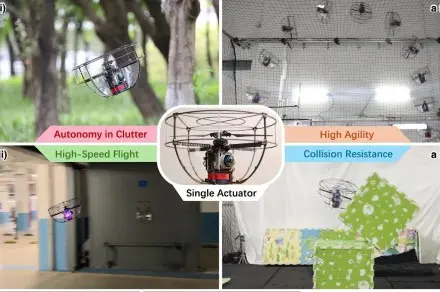
This single-propeller device tilts and spins to stay aloft
Researchers at the University of Hong Kong have unveiled a novel autonomous drone. This aircraft features only one propeller instead of the standard four. It rotates its entire body during flight to maintain stability. The design allows the machine to observe obstacles from nearly every angle simultaneously. This innovation challenges traditional aerial robotics assumptions. Most modern drones rely on quadcopter configurations. Four rotors provide lift and control. This standard approach limits the field of view for onboard cameras. The new Hong Kong prototype solves this problem through unique mechanics. The team engineered a system that uses rotation for balance. This allows a single camera to capture a panoramic view. The drone effectively acts as a spinning periscope in the air. Rotational Dynamics Enable 360-Degree Awareness The core innovation lies in how the drone manages stability. Traditional multi-rotor drones hover by balancing thrust across multiple arms.
Latest news
 Smart TVs frequently lose their Wi-Fi connection, leaving viewers staring at a spinning loading icon
 Why Ignoring Car Software Updates Is Risky
 Apple's foldable iPhone Duo introduces dual-display multitasking capabilities
 FCC Weighs Reciprocal Limits on Foreign Satellite Firms
This single-propeller device tilts and spins to stay aloft. As it rotates, the attached camera sweeps across the environment. This continuous motion creates a complete visual map of the surroundings. The system detects obstacles without needing multiple fixed cameras. Engineers optimized the flight path to ensure smooth rotation. This prevents motion blur in the captured video data. The result is a highly efficient sensor package. The device operates autonomously, navigating without human input. It processes visual data in real-time to avoid collisions. This capability is crucial for complex indoor environments. Tight spaces often restrict the view of standard drones. The spinning mechanism grants the aircraft superior spatial awareness. It can identify hazards on its sides and rear. This reduces the risk of crashes in cluttered areas. The technology represents a significant leap in aerial perception. How Does One Rotor Provide Stable Flight? The physics behind this drone are counterintuitive.
A single propeller cannot generate lift in all directions alone
A single propeller cannot generate lift in all directions alone. The drone uses gyroscopic effects to stabilize its orientation. It leans into its turn to maintain altitude. This motion is similar to a spinning top. The angular momentum keeps the aircraft upright. Sensors constantly adjust the tilt angle to correct drift. The flight controller runs complex algorithms at high speed. These calculations ensure the drone does not tumble. The system demonstrates that fewer parts can achieve complex tasks. Frequently Asked Questions Why does the drone spin during flight? The rotation is essential for stability with a single propeller. It also allows the camera to scan the entire environment continuously. Is this drone faster than a quadcopter? The source does not provide speed comparisons. The focus remains on field of view and obstacle detection capabilities. Where was this technology developed? Researchers at the University of Hong Kong created this prototype.
The team focused on improving aerial perception systems.
Comments
Leave a comment