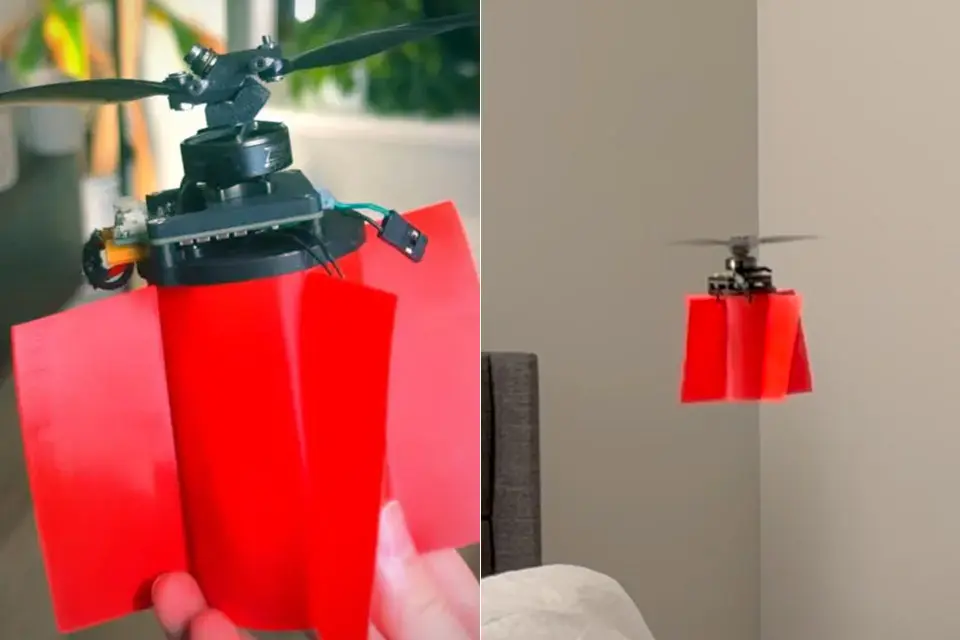
Bird emphasized that the design prioritizes simplicity and indoor usability
Joshua Bird developed a miniature drone designed to operate in confined indoor spaces using only a single propeller. The device eliminates the need for multiple rotors by incorporating a counter-torque mechanism that stabilizes flight without additional motors. Built to fit comfortably within a standard room, the prototype addresses common size and complexity issues associated with traditional single-rotor aircraft. The drone’s innovation lies in its ability to counteract rotational force generated by the spinning propeller through a movable mass system that shifts internally to balance torque. This approach avoids the inefficiencies of coaxial or multi-rotor setups while maintaining hover capability.
Latest news
 Major AI firms recorded peak lobbying expenses last summer
 Apple Magic Keyboards for iPad Drop to Half Price at Woot
 Microsoft Provides Fix for Broken Exchange Online Apps
 Security Breach at AI Aggregator Exposes 18 Million Files and Private Chats
Bird emphasized that the design prioritizes simplicity and indoor usability, targeting applications where space is limited and mechanical complexity must be minimized. How the Single-Motor System Maintains Stability Instead of relying on a second rotor to counteract spin, the drone uses an internal sliding weight that moves in opposition to the propeller’s rotation. As the motor spins the propeller in one direction, the weight shifts to the opposite side of the frame, generating a balancing force. This mechanical feedback allows the drone to remain level and hover without external stabilization systems. Bird noted that the system responds in real time to changes in thrust, adjusting the weight position dynamically to maintain equilibrium. Could This Design Scale for Larger Aircraft? While the current prototype is optimized for small, indoor use, Bird acknowledged that scaling the internal mass-balancing concept to larger vehicles presents engineering challenges.
He pointed out that increased inertia and power requirements would demand more
He pointed out that increased inertia and power requirements would demand more robust mechanisms, potentially complicating the simplicity that defines the design. However, he suggested that modified versions might find niche applications in compact aerial platforms where minimal moving parts are advantageous, such as in confined inspection or educational tools. The project demonstrates that flight stability does not inherently require multiple motors, offering an alternative path for micro-drone development. By focusing on mechanical ingenuity over added complexity, Bird’s work highlights how fundamental physics can be leveraged to achieve functional flight in constrained environments. Future iterations may explore lighter materials and faster response systems to improve agility and efficiency. Frequently Asked Questions How does the drone prevent spinning without a second rotor? It uses an internal sliding mass that moves opposite to the propeller’s rotation, creating a counteracting force that stabilizes the aircraft mechanically.
Is the drone capable of forward movement or only hovering? The current design focuses on stable hovering; directional control would require additional modifications not yet implemented in this prototype.
What materials were used in the prototype’s construction? The frame utilizes lightweight polymers and carbon fiber components to minimize weight while maintaining structural integrity for indoor operation.
Comments
Leave a comment