The model used was a trimmed-down version designed for efficiency
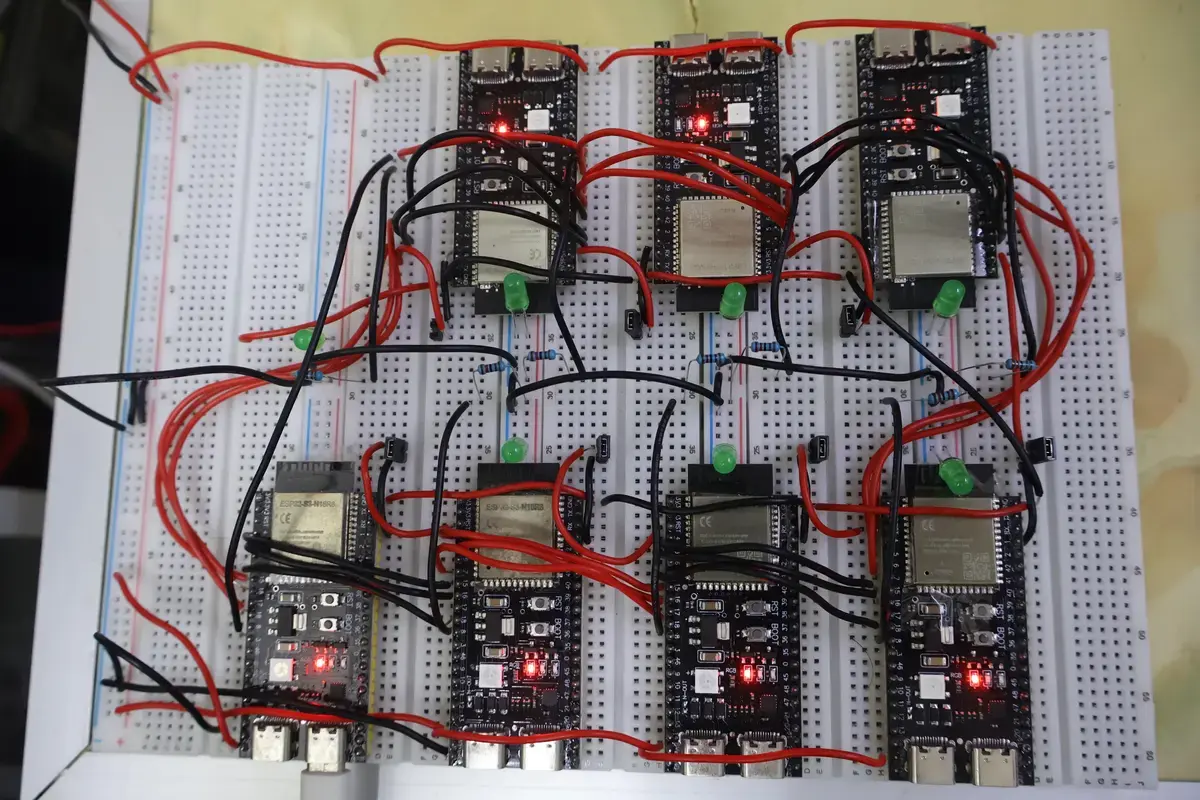
A hobbyist successfully connected seven ESP32 microcontrollers to run a language model with approximately 400 million parameters, demonstrating that distributed computing on low-cost hardware can handle AI tasks typically reserved for powerful servers. The project was completed in August 2026 and shared online as an open guide for others to replicate. The builder, Simon Batt, a computer science graduate and long-time technology writer, used off-the-shelf components to create a working prototype. The ESP32 chips, each costing just a few dollars, were linked together to share the computational load of processing the model. Instead of relying on a single high-performance processor, the system divides tasks across the seven boards, allowing them to work in parallel. This approach reduces the burden on any one chip and makes it feasible to run a model of this size without expensive hardware.
Latest news
 Anker Unveils Playful 45W Charger With Animated Face Display
 Google Docs Web Version Still Missing Native Dark Mode
 Anthropic-Linked Vulnerability Exploited From China, Targets US and Japan
 Text‑Based AI Agents: Your New Digital Assistants
The model used was a trimmed-down version designed for efficiency, capable of basic text generation and response generation. Batt emphasized that the goal was not to match the speed of cloud-based AI but to prove accessibility and educational value. How Distributed Processing Enables AI on Cheap Hardware By splitting the model’s operations across multiple ESP32s, each handles a portion of the neural network’s calculations during inference. Communication between boards happens over a local network, with data synchronized to maintain coherence. The system does not achieve real-time performance but can process prompts and generate replies within a reasonable timeframe for experimentation. Batt noted that memory constraints on individual ESP32s required careful model quantization and layer distribution. He shared detailed wiring diagrams and code to help others avoid common pitfalls in setup and debugging.
The project highlights how modular design can overcome individual hardware
The project highlights how modular design can overcome individual hardware limitations. Can This Approach Scale to Larger Models? While seven ESP32s suffice for a 400-million-parameter model, Batt acknowledged that significantly larger models would require more boards or hybrid solutions involving additional memory or processing aids. Power consumption and heat management also become factors at scale, though the ESP32’s efficiency helps mitigate these issues. He suggested that future iterations could explore combining ESP32s with external storage or accelerator modules to improve throughput. The experiment serves as a proof of concept rather than a practical replacement for commercial AI infrastructure. Still, it opens doors for learning about model partitioning, parallel computing, and embedded AI development. Frequently Asked Questions Is this setup useful for real-world applications? Not for high-speed or production use, but it is valuable for education, prototyping, and understanding how AI models can be split across devices.
What skills are needed to build this? Basic electronics, programming in C or Python with ESP32 frameworks, and familiarity with neural network concepts help, though Batt’s guide simplifies the process. Can other microcontrollers be used? Yes, the principle applies to any capable board, but ESP32 was chosen for its balance of cost, Wi-Fi, and processing power.
Comments
Leave a comment