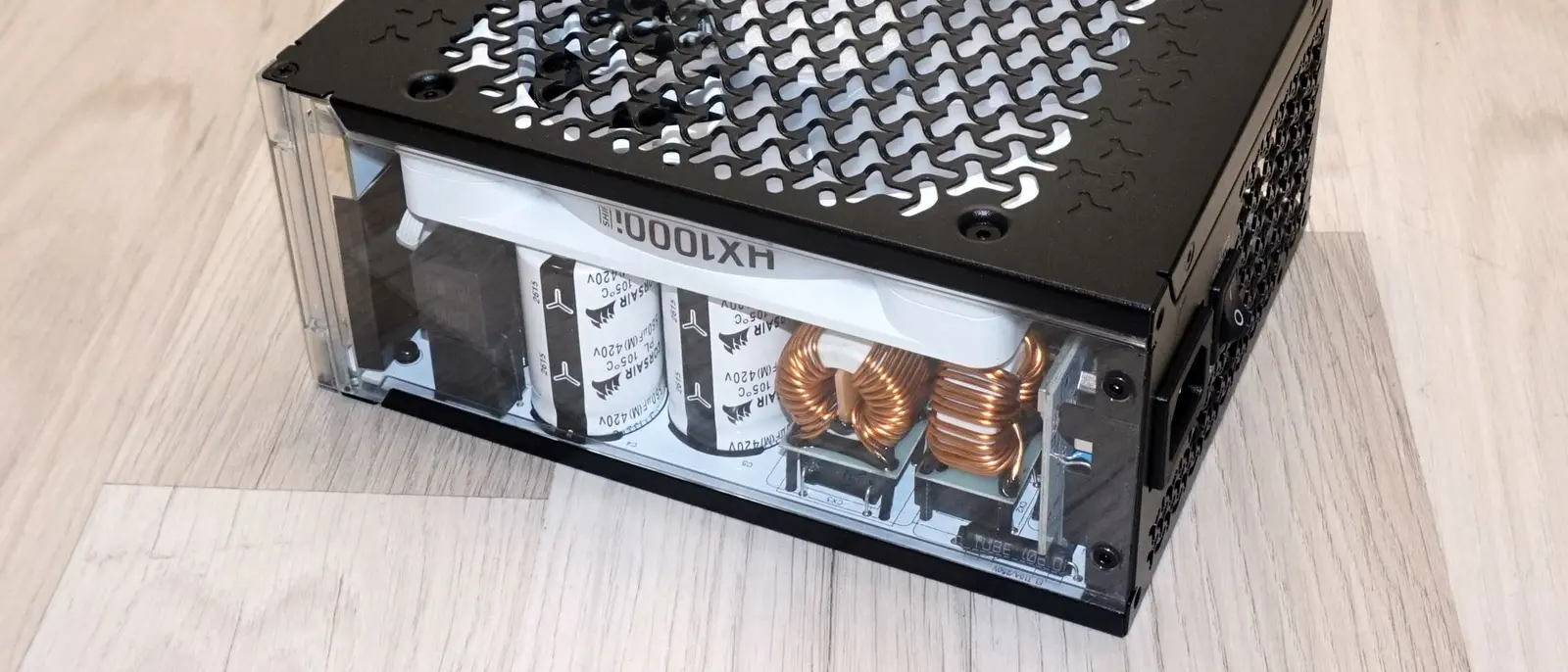
Can You See the Internals?
Corsair has released the HX1000i Shift Crystal, a 1000W Platinum-rated power supply featuring a transparent side panel that exposes the internal components. The unit is built by CWT and targets enthusiasts who value both performance and aesthetics. It ships with a 200mm long chassis and a fanless window covering half its rated output at room temperature.
Latest news
 Smart TVs frequently lose their Wi-Fi connection, leaving viewers staring at a spinning loading icon
 Why Ignoring Car Software Updates Is Risky
 Apple's foldable iPhone Duo introduces dual-display multitasking capabilities
 FCC Weighs Reciprocal Limits on Foreign Satellite Firms
The transparent design reveals the internal architecture, including the capacitors and circuitry. Corsair chose this look to differentiate the product in a crowded market. The efficiency rating meets Cybenetics Platinum standards, ensuring low power loss under load.
Is the Fan Noisy Under Load?
Yes. The side panel is fully transparent, allowing users to observe the fan, capacitors, and PCB layout. This design choice appeals to builders who want a visible power supply in their case. The window covers roughly half of the rated output range under typical operating temperatures.
The fan operates silently at low loads but becomes audible when the unit approaches its full 1000W capacity. Reviewers noted a noisy hot run as one of the main compromises. Despite this, the overall performance remains strong, with tight voltage regulation and low ripple measurements.
Is the HX1000i Shift Crystal compatible with standard ATX cases? Yes, the 200mm length fits most full-size ATX cases. Users should verify clearance in smaller form factors.
Frequently Asked Questions
What efficiency rating does the HX1000i Shift Crystal carry? It holds a Cybenetics Platinum certification, indicating high efficiency across a wide load range.
Can the transparent panel be removed or replaced? The panel is designed as a fixed aesthetic feature. Corsair does not list it as a user-replaceable component in standard documentation.
Comments
Leave a comment