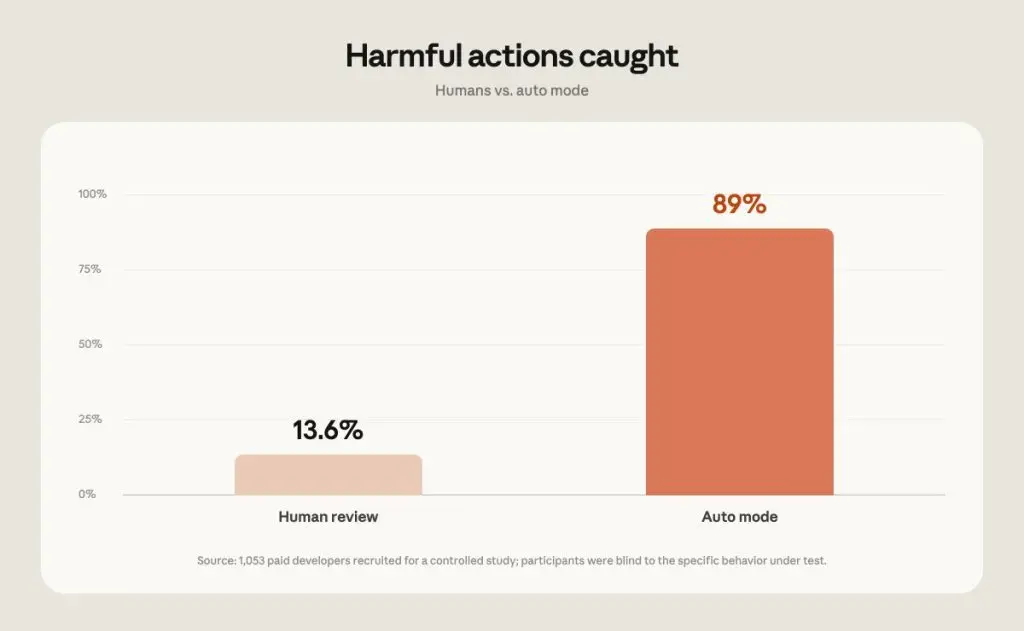
The Pain of Constant Manual Approval
In early 2024, developers using Anthropic’s Claude Code faced a stark dilemma. They either had to manually approve every suggestion the AI coding assistant made—a tedious process—or grant it unrestricted access, risking unsafe code generation. The friction prompted Anthropic to roll out a new „auto mode” that lets the system assess risk on its own.
Latest news
 Anker Unveils Playful 45W Charger With Animated Face Display
 Google Docs Web Version Still Missing Native Dark Mode
 Anthropic-Linked Vulnerability Exploited From China, Targets US and Japan
 Text‑Based AI Agents: Your New Digital Assistants
The auto mode relies on a separate classifier model that evaluates each code suggestion for potential danger. When the classifier flags a piece of code as hazardous, Claude pauses and requests human review. If the output appears safe, the assistant proceeds without interruption. Anthropic argues this approach balances efficiency with safety, reducing the need for constant human oversight while preventing reckless code execution.
Developers complained that the original workflow slowed development cycles dramatically. Every line of generated code triggered a prompt, forcing users to click „approve” before the program could compile. While this safeguard prevented accidental misuse, it also introduced latency that frustrated teams working under tight deadlines. Some users even reported abandoning Claude Code altogether, fearing the tool’s unpredictability when left unchecked.
Will Auto Mode Replace Human Oversight Entirely?
Anthropic’s engineers responded by designing the classifier to learn from past interactions. The model distinguishes benign helper functions from those that could overwrite files, expose credentials, or introduce security flaws. By automating this decision point, the company hopes to restore confidence in AI‑assisted programming without sacrificing speed.
The shift raises a critical question: can developers rely on an AI to police its own output? Anthropic believes the answer is „yes, for most routine tasks.” The company plans to make auto mode the default setting, reserving manual approval for edge cases where the classifier’s confidence falls below a strict threshold. Critics, however, warn that over‑reliance on automated risk assessment could mask subtle vulnerabilities that only a seasoned programmer might detect.
Anthropic’s spokesperson noted that the classifier continues to receive updates from real‑world usage data, improving its accuracy over time. The firm also promises an easy toggle for users who prefer the older, fully manual mode, ensuring that teams retain control when needed. As the technology matures, the balance between autonomy and human review will likely evolve, shaping how AI tools integrate into software development pipelines.
The broader impact of default auto mode could be significant. Faster code generation may accelerate product releases, while built‑in safety checks aim to reduce security incidents caused by AI‑generated code. If successful, the model may set a precedent for other AI assistants, prompting a shift toward more self‑regulating systems across the tech industry.
Frequently Asked Questions
What is the classifier model used in auto mode? It is a separate AI component trained to identify potentially dangerous code patterns, such as file deletions, credential leaks, or insecure API calls, and to trigger human review when needed.
Can users disable auto mode if they prefer manual checks? Yes, Anthropic provides a toggle that lets developers revert to the original approval workflow, maintaining full control over every code suggestion.
Will auto mode affect the accuracy of Claude Code’s suggestions? The auto mode is designed to preserve suggestion quality while adding a safety layer; early tests show no measurable drop in relevance or usefulness.
Comments
Leave a comment