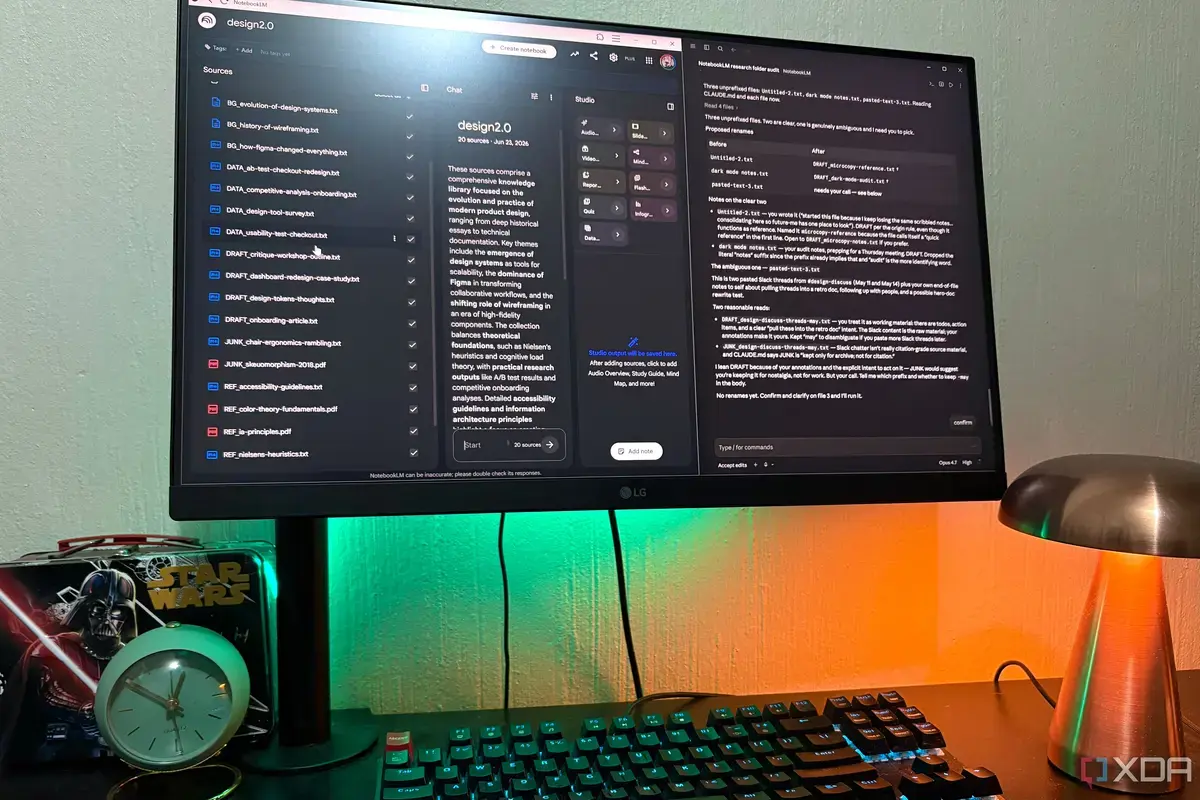
How Claude Code Reshaped the Notebook Structure
Nolen Jonker, a technology writer, granted Anthropic’s Claude Code access to their personal NotebookLM collection in June 2026. The experiment took place on Jonker’s home computer, where dozens of research notes, drafts, and multimedia links had accumulated over three years. Claude Code was tasked with sorting the material into a coherent, searchable library.
Latest news
 Anker Unveils Playful 45W Charger With Animated Face Display
 Google Docs Web Version Still Missing Native Dark Mode
 Anthropic-Linked Vulnerability Exploited From China, Targets US and Japan
 Text‑Based AI Agents: Your New Digital Assistants
Jonker had struggled to locate files amid the growing chaos of untagged pages and scattered references. By feeding the AI the raw notebook data, they hoped to test whether machine learning could impose order where manual curation failed. Claude Code analyzed content, identified themes, and generated a hierarchical taxonomy that grouped related topics, added descriptive tags, and created cross‑links between entries. The result was a clean, navigable structure that reduced search time dramatically.
Claude Code began by scanning each NotebookLM page for keywords, headings, and embedded media. It then clustered notes into five primary categories: „Creative Workflow,” „Technical Tutorials,” „Project Planning,” „Reference Material,” and „Personal Reflections.” Within each category, the AI assigned sub‑tags such as „Video Editing,” „Python Scripts,” and „Brand Guidelines.” Jonker noted that the AI’s tagging matched their own mental model more closely than any previous manual system. The AI also suggested links between seemingly unrelated notes, revealing hidden connections that sparked new ideas. In tests, Jonker’s average time to locate a specific draft dropped from 12 minutes to under two minutes.
Can AI Replace Human Curation in Personal Knowledge Bases?
The success of Claude Code raises questions about the future role of humans in personal knowledge management. While the AI excelled at pattern recognition and bulk organization, Jonker observed that nuanced judgments—like deciding which drafts to keep or discard—still required a human touch. Moreover, the AI occasionally misinterpreted ambiguous titles, creating redundant tags that needed manual correction. Nonetheless, the experiment demonstrates that AI can handle the heavy lifting of sorting and indexing, freeing users to focus on creative synthesis and critical review.
The experiment suggests a shift toward hybrid workflows where AI handles initial organization and humans refine the output. As personal knowledge bases expand, tools like Claude Code could become essential for maintaining productivity and preventing information overload. Jonker plans to integrate the AI’s taxonomy into a public guide, hoping others will benefit from a more efficient approach to digital note‑keeping.
Frequently Asked Questions
What is Claude Code? Claude Code is an AI model from Anthropic designed to process and restructure text data, offering automated tagging, categorization, and linking capabilities.
How does NotebookLM differ from other note‑taking apps? NotebookLM combines AI‑assisted writing with cloud‑based storage, allowing users to embed text, images, and code while leveraging built‑in search and summarization tools.
Will AI eventually manage all personal knowledge bases? AI can automate many organizational tasks, but human oversight will likely remain crucial for contextual decisions, quality control, and creative direction.
Comments
Leave a comment