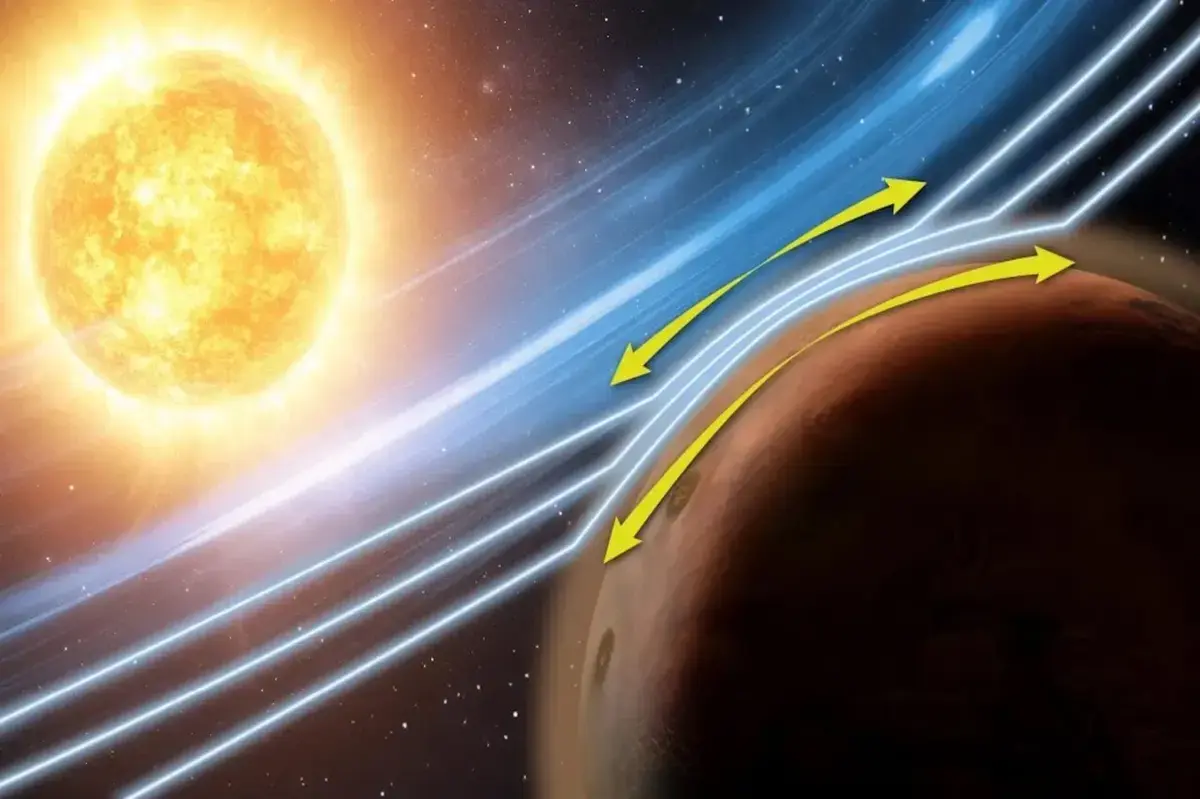
Unforeseen Space Weather Phenomenon
NASA's Mars Atmosphere and Volatile Evolution spacecraft made a groundbreaking discovery on Mars. The event occurred during a solar storm. Scientists were baffled by the unexpected finding.
Latest news
 Anker Unveils Playful 45W Charger With Animated Face Display
 Google Docs Web Version Still Missing Native Dark Mode
 Anthropic-Linked Vulnerability Exploited From China, Targets US and Japan
 Text‑Based AI Agents: Your New Digital Assistants
The Martian environment is characterized by its dusty and cold conditions. Additionally, Mars lacks a global magnetic field. These factors make the planet an unlikely place for certain space weather phenomena.
What Does This Mean for Our Understanding of Mars?
The detected phenomenon is known as the Zwan-Wolf effect. It was previously associated with powerful magnetic fields. Scientists used data from NASA's MAVEN mission to identify the effect deep inside Mars' ionosphere.
The discovery has left scientists questioning their current understanding of the Martian ionosphere. „The observation of the Zwan-Wolf effect on Mars is a significant finding,”said researchers. They added that it challenges existing theories about the planet's interaction with the solar wind.
The Zwan-Wolf effect is a complex phenomenon that involves the interaction between the solar wind and a planet's magnetic field. On Mars, the lack of a strong magnetic field makes this interaction unique.
Can This Discovery Shed Light on Mars' Past?
The discovery could provide new insights into Mars' past. By studying the Zwan-Wolf effect on Mars, scientists may be able to learn more about the planet's evolution. This could help researchers better understand how Mars' atmosphere has changed over time.
The finding has significant implications for future studies of the Martian environment. As scientists continue to analyze data from MAVEN, they may uncover more surprises about the Red Planet.
Q: What is the Zwan-Wolf effect? A: The Zwan-Wolf effect is a space weather phenomenon typically associated with powerful magnetic fields. It was unexpectedly detected on Mars.
Frequently Asked Questions
Q: Why is the discovery significant? A: The finding challenges existing theories about Mars' interaction with the solar wind and could provide new insights into the planet's evolution.
Q: What does this mean for future Mars research? A: The discovery has significant implications for future studies of the Martian environment, and scientists may uncover more surprises about the Red Planet.
Comments
Leave a comment