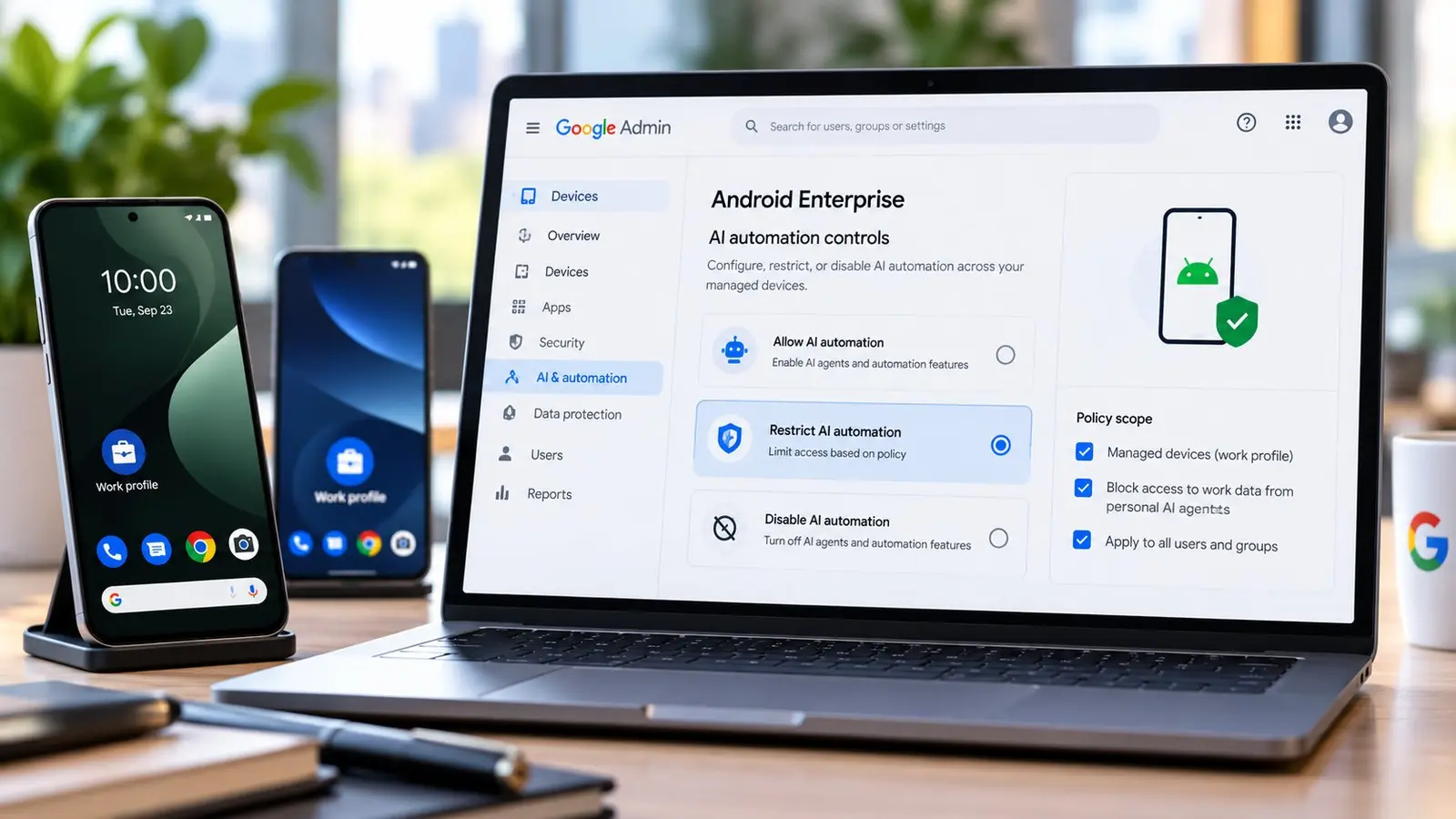
Centralized Management of AI Automation
These updates follow significant evolution in the Gemini platform. It now executes complex, interconnected tasks across various Android applications. For instance, an AI agent can search emails, check calendars, and extract data from web browsers. This transforms access to corporate data into a critical security variable. The technical details were presented on September 23, 2026. The primary goal is facilitating AI agent adoption while protecting company data from unauthorized access or excessive use. Google has not yet specified which devices or management platforms support these controls. It also lacks details on how each policy is configured at the system level.
Latest news
 Major AI firms recorded peak lobbying expenses last summer
 Apple Magic Keyboards for iPad Drop to Half Price at Woot
 Microsoft Provides Fix for Broken Exchange Online Apps
 Security Breach at AI Aggregator Exposes 18 Million Files and Private Chats
Isolating Personal AI Agents from Work Data
The first pillar involves centralized management of AI automation across managed device fleets. Administrators can now configure, restrict, or completely disable AI automation features using specific management policies. This flexibility allows companies to impose clear limits on employee usage of automated AI functions. They no longer rely exclusively on individual end-user settings. However, Google has not published detailed specifications for policy settings or associated management commands. It remains unclear if administrators can restrict individual agents, specific actions, or distinct data sources. Therefore, IT teams should verify available settings directly with Google or their Enterprise Mobility Management provider before integrating these controls into implementation plans.
The second pillar focuses on isolating personal AI agents from service data. A key component is robust work profile separation. Google states that integrated protection mechanisms prevent personal AI agents from accessing corporate applications and data stored within an Android work profile. This measure is highly relevant for organizations adopting Bring Your Own Device models. Here, employees use personal phones for professional activities. Android work profiles physically and logically separate business apps from personal activities. For administrators, the major challenge is ensuring this separation barrier remains intact. This is crucial as AI agents begin operating transversally across multiple applications simultaneously. While Google describes this protection as part of the native security model, the announcement lacks full technical details on cross-app interaction handling.
Supporting Complex Tasks
The third area of interest concerns supporting complex tasks for Gemini. According to the company, Gemini can now use real-time screen context to finish multi-step tasks distributed across several applications. A concrete example is an agent consulting calendar events, inbox messages, and browser information simultaneously to fulfill a request. This reduces the need for users to manually switch between different interfaces. These capabilities open new productivity opportunities but raise important transparency questions. Specifically, what information can the agent see, and what actions is it authorized to execute? The Google announcement explicitly links the expansion of Gemini automation to enterprise management mechanisms and work profile safeguards. This suggests a holistic approach to integrating AI into corporate infrastructure. In conclusion, these updates aim to give administrators fine-grained control over AI in mobile devices. They ensure that efficiency gained by AI agents does not come at the expense of organizational data safety.
Comments
Leave a comment