How the CLFS Driver Flaw Works
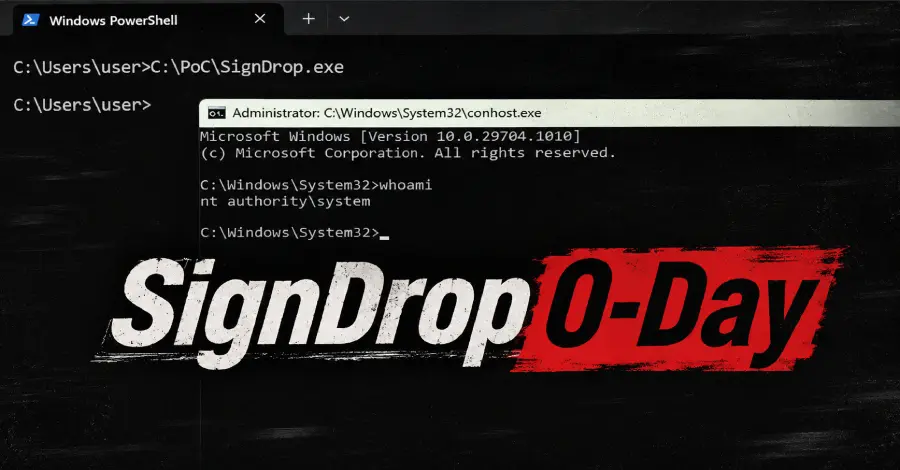
A new zero-day exploit called SignDrop has been made public, allowing any local Windows user to escalate to SYSTEM privileges. The vulnerability targets the Common Log File System driver, specifically a log-authentication feature introduced last year.
Latest news
 Smart TVs frequently lose their Wi-Fi connection, leaving viewers staring at a spinning loading icon
 Why Ignoring Car Software Updates Is Risky
 Apple's foldable iPhone Duo introduces dual-display multitasking capabilities
 FCC Weighs Reciprocal Limits on Foreign Satellite Firms
The proof-of-concept code reveals how clfs.sys creates companion files when a privileged process opens a prepared log. Attackers can abuse this behavior to hijack the authentication flow and elevate their own account to full administrative control.
Why This Matters for Windows Security
The exploit manipulates the driver's file-creation logic. When a high-privilege process opens a log file, the driver automatically generates a companion file. SignDrop leverages this predictable behavior to inject or replace the companion file, effectively bypassing the authentication check. This turns a security feature into an attack vector.
The discovery highlights how new security mechanisms can introduce fresh attack surfaces. The log-authentication feature was designed to protect log integrity, yet SignDrop shows it can be subverted by a local user with basic access. Security researchers emphasize that driver-level bugs remain a persistent risk for enterprise Windows environments.
Can any local user exploit SignDrop? Yes. The exploit requires only a standard local account, making it accessible to a wide range of attackers without needing existing elevated privileges.
Frequently Asked Questions
Is a patch available yet? No official patch has been released. Microsoft is aware of the issue and is working on a fix, but users should monitor for updates.
Does SignDrop work on all Windows versions? The exploit targets the CLFS driver, which is present in modern Windows releases. Older versions without the log-authentication feature are not affected.
Comments
Leave a comment