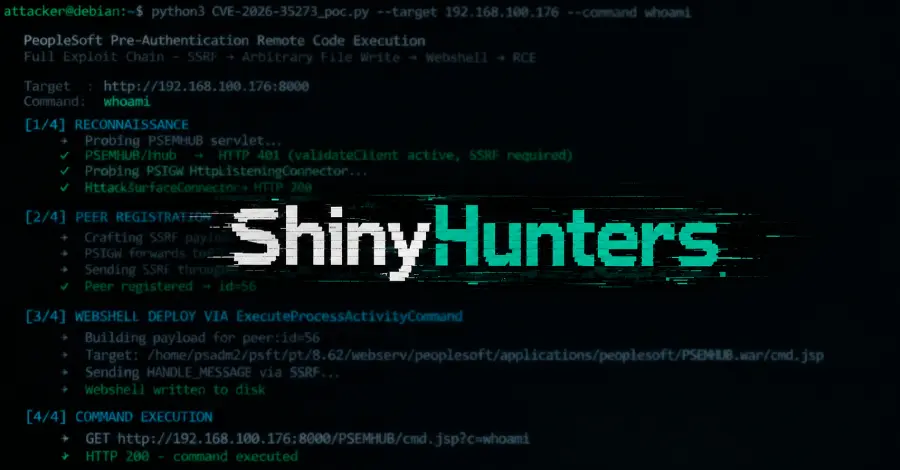
Anatomy of the PeopleSoft Exploit Chain
Cybersecurity researchers revealed this week that a severe security flaw exploited by the malicious group ShinyHunters since May actually consists of three distinct vulnerabilities chained together. Oracle addressed the complex issue under a single designation, CVE-2026-35273, during its June security updates after experts reported the active exploitation.
Latest news
 Smart TVs frequently lose their Wi-Fi connection, leaving viewers staring at a spinning loading icon
 Why Ignoring Car Software Updates Is Risky
 Apple's foldable iPhone Duo introduces dual-display multitasking capabilities
 FCC Weighs Reciprocal Limits on Foreign Satellite Firms
The attack chain originates from a server-side request forgery weakness that allows malicious actors to access an internal management interface. Attackers leverage this initial entry point to bypass standard security controls and execute unauthorized commands on vulnerable corporate infrastructure.
How Did Hackers Bypass Enterprise Defenses?
Security analysts explained that the complexity of the attack caught many defenders off guard because it bridged multiple system layers. By combining the server-side request forgery with internal interface access, the threat actors achieved persistent unauthorized entry.
Oracle grouped the patches for all three underlying weaknesses into one advisory to streamline the deployment process for system administrators. Organizations running unpatched versions of the enterprise software remained at high risk until applying the mandatory June updates.
The campaign orchestrated by ShinyHunters demonstrated how sophisticated groups exploit complex enterprise applications by stringing together minor weaknesses. Organizations must audit their systems regularly to ensure no legacy or secondary interfaces remain exposed to internal request forgery vectors.
Frequently Asked Questions
The exposure highlights the growing trend of attackers leveraging multi-stage vulnerabilities rather than relying on single-point entry methods. Companies running legacy PeopleSoft installations face ongoing risks unless they have verified the complete application of the June security patches.
Q: When did attackers begin exploiting this vulnerability? A: Malicious actors belonging to the ShinyHunters group started exploiting the weakness actively in May before Oracle issued patches.
Comments
Leave a comment