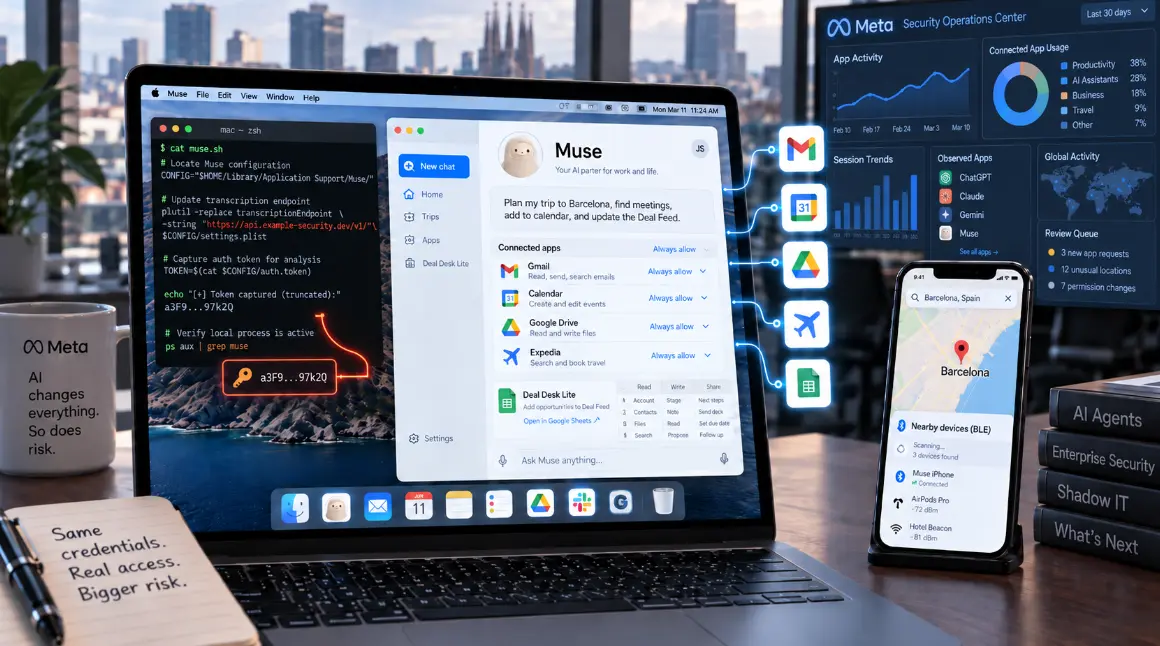
How the Exploit Bypassed Standard macOS Protections
Patrick Wardle disclosed a zero-day vulnerability in Meta’s Muse macOS application on Monday, September 22, 2026, which allowed malware already operating under a user’s account to hijack the agent’s authentication mechanisms. The flaw enabled unauthorized access to sensitive system functions without triggering typical security alerts. Meta confirmed the issue was patched shortly after disclosure, though specific technical details of the fix were not made public. Security researchers warn that while the immediate threat is addressed, the incident highlights a broader challenge in monitoring agent-based AI tools on endpoint devices.
Latest news
 Anker Unveils Playful 45W Charger With Animated Face Display
 Google Docs Web Version Still Missing Native Dark Mode
 Anthropic-Linked Vulnerability Exploited From China, Targets US and Japan
 Text‑Based AI Agents: Your New Digital Assistants
The vulnerability leveraged legitimate inter-process communication channels that Muse uses to interact with system services, allowing malicious code to inject commands under the guise of trusted operations. Because the agent runs with user-level privileges and is designed to perform automated tasks, it was not flagged by conventional endpoint detection tools that focus on known malware signatures or privilege escalation attempts. Wardle explained that the exploit did not require bypassing Gatekeeper or XProtect, as it abused the agent’s intended functionality rather than exploiting a traditional software bug. This made detection particularly difficult for security teams relying on behavioral baselines that assume agent actions are inherently safe.
Why Security Teams Struggle to Monitor AI Agent Activity
Unlike traditional applications, AI agents like Muse operate with dynamic, context-aware behaviors that change based on user input and environmental factors, making static rule-based monitoring ineffective. Security teams often lack visibility into the specific data, files, or system resources an agent accesses during operation, especially when those actions occur within legitimate user sessions. There is currently no standardized logging framework for AI agents that captures intent-based actions in real time, leaving gaps in audit trails. As a result, even when an agent is compromised, investigators may be unable to reconstruct exactly what data was accessed or modified, hindering incident response and forensic analysis.
Experts argue that securing AI agents requires a shift from perimeter-based defenses to runtime integrity monitoring that tracks agent behavior, data access patterns, and decision logic in real time. This includes implementing agent-specific audit logs that record not just what actions were taken, but why they were triggered based on contextual inputs. Additionally, operating system vendors may need to introduce new security frameworks that treat AI agents as distinct trust domains, similar to how sandboxing isolates applications. Until such measures are adopted, organizations using agent-based AI tools will continue to face significant challenges in detecting and responding to stealthy compromises that abuse legitimate functionality.
What Measures Are Needed to Secure AI Agents Going Forward?
How did the malware gain access to the Muse agent? The malware did not need to exploit a software vulnerability in Muse itself; instead, it hijacked the agent’s existing authentication and communication channels while running under the same user account, allowing it to send malicious commands that appeared legitimate.
Frequently Asked Questions
Why couldn’t traditional antivirus tools detect this attack? Because the exploit used the agent’s own legitimate functions to perform unauthorized actions, it avoided triggering signatures associated with known malware, code injection, or privilege escalation, making it invisible to conventional detection methods that rely on behavioral anomalies or file-based indicators.
What should organizations do to protect against similar threats? Organizations should monitor agent activity through specialized logging tools that capture contextual behavior, restrict agent permissions to the minimum necessary, and treat AI agents as potential attack surfaces requiring dedicated security controls beyond standard endpoint protection.
Comments
Leave a comment