Can Consumer Hardware Match Enterprise Decoding Speeds?
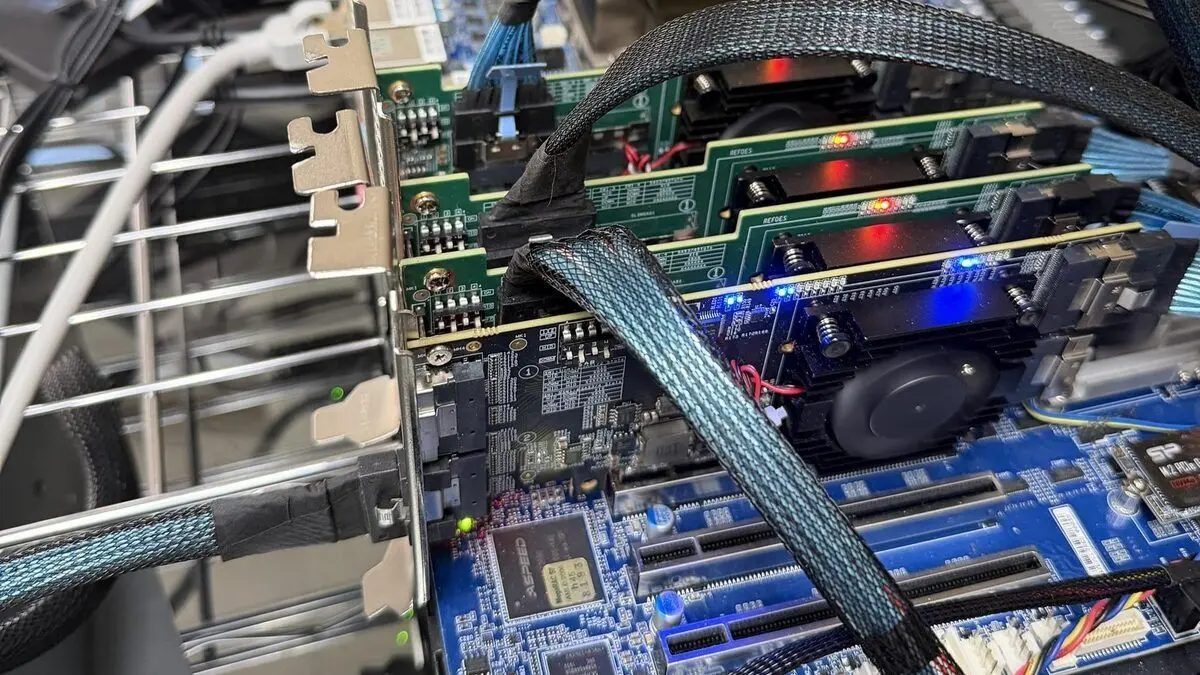
A legal professional recently expanded his personal artificial intelligence infrastructure by adding four graphics cards to an existing setup. The new configuration includes twelve used Nvidia V100 units. This upgrade allows the system to host every specialized version of the DeepSeek V4.1 Flash model. The total cost for this hardware expansion is approximately $9,450. This project demonstrates that high-performance local computing remains accessible without enterprise-grade budgets.
Latest news
 Smart TVs frequently lose their Wi-Fi connection, leaving viewers staring at a spinning loading icon
 Why Ignoring Car Software Updates Is Risky
 Apple's foldable iPhone Duo introduces dual-display multitasking capabilities
 FCC Weighs Reciprocal Limits on Foreign Satellite Firms
The primary goal was to increase processing speed and reduce latency for complex tasks. By moving to a larger cluster, the lawyer aims to handle longer documents more efficiently. The system now operates using 4-bit NVFP4 precision. This quantization method significantly reduces memory requirements while maintaining acceptable accuracy. It enables the server to run multiple expert models simultaneously. The hardware choice focuses on maximizing throughput rather than raw peak performance.
Performance benchmarks reveal impressive results for this compact array. The system achieves up to 184 tokens per second when generating code. This speed is particularly relevant for developers and technical users relying on local inference. Response times for long-form documents have dropped by roughly fifty percent compared to the previous eight-card setup. The lawyer claims this configuration outperforms published benchmarks for specific DGX Spark stacks during decoding phases. Such speeds are typically associated with much more expensive, power-hungry data center equipment. The efficiency gain comes from optimized software layers working with older but capable GPU architecture.
Why Choose Older Nvidia Chips For Local Inference?
The decision to use used V100 cards reflects a strategic balance between cost and capability. These chips offer sufficient memory bandwidth for large language models despite their age. Buying used hardware keeps the total investment under ten thousand dollars. This price point makes it viable for individual professionals and small teams. The approach avoids the high upfront costs of brand-new consumer or data center GPUs. It also reduces the environmental footprint associated with manufacturing new silicon. Users can scale their systems incrementally as needs grow. This modular strategy provides flexibility that monolithic supercomputers often lack.
The success of this build suggests a broader shift in how individuals access advanced AI tools. Relying on cloud services is no longer the only option for high-speed inference. Local servers offer greater privacy and lower long-term operational costs. As model sizes continue to grow, efficient quantization methods become essential. This project proves that thoughtful hardware selection can bridge the gap between home labs and corporate facilities. Future upgrades may focus on even faster interconnects or newer chip architectures. For now, the twelve-card V100 rig serves as a robust and economical solution for daily AI workloads.
Frequently Asked Questions
How much does the full server cost? The total expenditure for the twelve-GPU configuration is approximately $9,450. This covers the used Nvidia V100 cards and necessary supporting components.
What is the maximum token generation speed? The system reaches up to 184 tokens per second when processing code tasks. This metric highlights its efficiency for programming assistance.
Does the server support all DeepSeek variants? Yes, the hardware supports every expert model within the DeepSeek V4.1 Flash family. It runs them effectively using 4-bit NVFP4 precision settings.
Comments
Leave a comment